United States
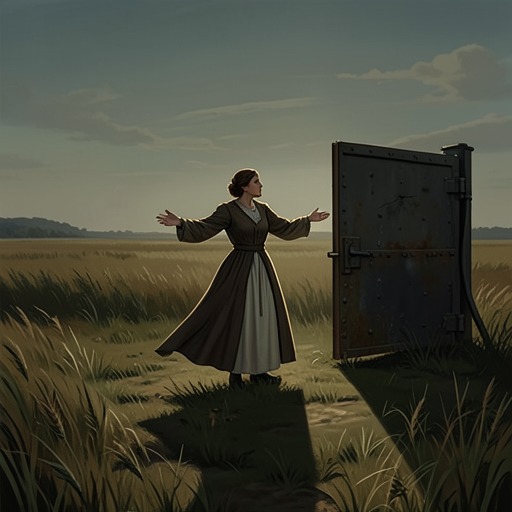
The Color PurpleThe United States is both the ground of Celie and Nettie’s early lives and the place to which Nettie’s family hopes to return. It carries the history of enslavement and racial violence that Nettie encounters in her reading, while its homes, prisons, and public offices shape the sisters’ experiences of separation, constraint, and belonging. The novel’s movement between the United States, Europe, and Africa makes home more than a point on a map: it is at once a remembered origin, a site of injustice, and the setting of an anticipated reunion.
Home Ground and Historical Memory
Celie’s life in the United States begins under conditions that narrow her choices. At fourteen, she writes of having been a good girl and asks for a sign to explain what is happening to her. Her later life remains tied to this early vulnerability: she is married to Albert in a relationship marked by abuse, while her sister Nettie leaves and the two lose contact for nearly thirty years. In Nettie’s absence, letters preserve a connection across distance, even when Celie’s circumstances make the idea of a secure home difficult to imagine.
Nettie’s understanding of the United States changes as she reads about the history that links Africa and Black Americans. She learns that Africans were sold for money, transported to America by ship, and made to work. The account unsettles her with questions about why people were sold and why love for them could persist. Her reading places the family’s personal separation within a much longer history of forced migration and labor: the United States is not simply where the sisters’ lives began, but a country shaped by the consequences of that history.
Nettie also tells Celie of a prosperous Black farmer in their town who owned property, ran a store, and established a blacksmith shop behind it. White merchants objected to his success, arguing that the store drew Black customers away from them and the smithy took business from white tradesmen. The store and smithy were burned, and the farmer and his two brothers were lynched. The episode makes economic success and property ownership precarious under racial domination. Its place in Nettie’s letters gives the violence a double force: it is a local history of dispossession and a family account of what racial power can do to Black enterprise.
Institutions, Labor, and Racial Exclusion
The United States is also represented through the institutions that confine and manage Black lives. Sofia is made to work in a prison laundry from five until eight, surrounded by convict clothing and bedding. Celie and the others are permitted to visit her only twice a month, for half an hour. The strict limits on visits and the prison labor routine show how incarceration separates Sofia from her community as well as restricting her freedom.
After prison, Sofia describes being kept in a small storeroom beneath a house and required to answer demands throughout the day and night. She is barred from seeing her children and men; even contact with her visitors is severely limited, becoming once a year after five years. Her account connects the prison to a second form of coerced domestic labor. Though the settings differ, both restrict where Sofia can go, whom she can see, and how she can spend her time.
Public agencies offer little reassurance when Nettie’s family is reported missing. Shug and Germaine go to the U.S. Department of State to seek information, but the effort produces no answer; the U.S. Department of Defense is equally unable to help. The episode is set against a large war and the loss of a ship, circumstances in which the family’s fate appears to be treated as negligible. Celie’s understanding is sharpened by the racial disregard she perceives: the agencies’ silence does not end her attachment to Nettie, but leaves her to wait without reliable news.
Language, Work, and Belonging
The United States is not only a setting of overt coercion; it is also where everyday judgments shape how people are heard. Jerene and Darlene, twin sisters who help Celie with her business and love to sew, try to teach her to speak differently. Darlene corrects Celie’s use of us in place of we, warning that others may take it as evidence that she is unintelligent or a hick, while white people may find it amusing. The correction places Celie between different audiences and their standards of speech.
Celie says that the repeated corrections leave her confused and make it harder to pursue a thought. Darlene believes Celie will feel happier speaking as she does, but Celie privately values seeing Nettie again more than changing her speech. When Shug Avery is home, Darlene asks whether Celie should learn to speak properly; Celie objects that Shug Avery is not ashamed of how she speaks. These moments show how a language lesson can become a question of whose ways of speaking count as legitimate. Celie’s voice is not presented as an obstacle to her intelligence; rather, the pressure to alter it becomes another negotiation between acceptance and self-possession.
Property, Return, and Reunion
The prospect of owning a home marks a change in Celie’s relationship to the United States. She says that she has never had a house of her own and that the thought of having one frightens her. The house she is to get is larger than Shug Avery’s, with more land around it and a store. Its scale and attached business distinguish it from mere shelter: it offers Celie a material foothold and a place from which to pursue her own work.
For Nettie, return to the United States becomes a family plan after decades away. As she and Samuel prepare to come home, Adam and Olivia ask about Celie, whom they have never known through direct contact. Nettie sometimes tells them that Tashi reminds her of Celie, and she wonders whether years of childbearing and abuse by Albert have changed her sister. Samuel counsels faith in Celie’s resilience. The letter holds together the distance of nearly thirty years and the family’s expectation that it can still be crossed.
When Nettie’s family is mistakenly reported missing, Celie continues to believe that Nettie is on her way home, even though she cannot know when they will meet. The United States thus becomes the destination of a reunion suspended by false news and unanswered inquiries, but not erased by them. The country’s meaning remains divided: its history and institutions expose racial violence and neglect, while Celie’s house, her continuing letters, and her expectation of seeing Nettie again make it a possible place of self-determination and renewed kinship.